TL;DR

Get home appliances delivered free with Prime
- Fast, free delivery on millions of items
- Prime Video, Amazon Music and more included
- Member-only deals all year
Livingetc has published four Japanese tablescaping ideas for autumn hosting: combine individual place settings with shared dishes, choose tableware for the person using it, match vessels to the food, and bring in seasonal pieces. The article presents these as design practices that can be adapted to Western homes, not as a report of a new study or formal trend survey.
Livingetc has published a guide to four Japanese tablescaping practices for making autumn meals feel more personal and welcoming, with ideas that can be adapted to Western homes. The report focuses on how hosts arrange individual settings and shared food, select vessels for the people and dishes at the table, and use seasonal ceramics rather than changing the whole room.
The first recommendation is to combine individual place settings with shared dishes, echoing Japanese kitchen organization ideas. The report describes an oshiki, a flat tray set before each person with a rice bowl, soup bowl and small plate. Larger platters sit in the middle, allowing guests to take food as the meal goes on. Livingetc says the approach brings together the structure of plated dining and the informality of family-style service.
The second lesson is to choose some tableware for the person who will use it, rather than relying on a uniform set. The article describes family members having their own rice bowls and chopsticks, selected for details such as hand size and preferred grip. That personal approach can coexist with mixed pieces, the report says, rather than requiring every plate and bowl to match.
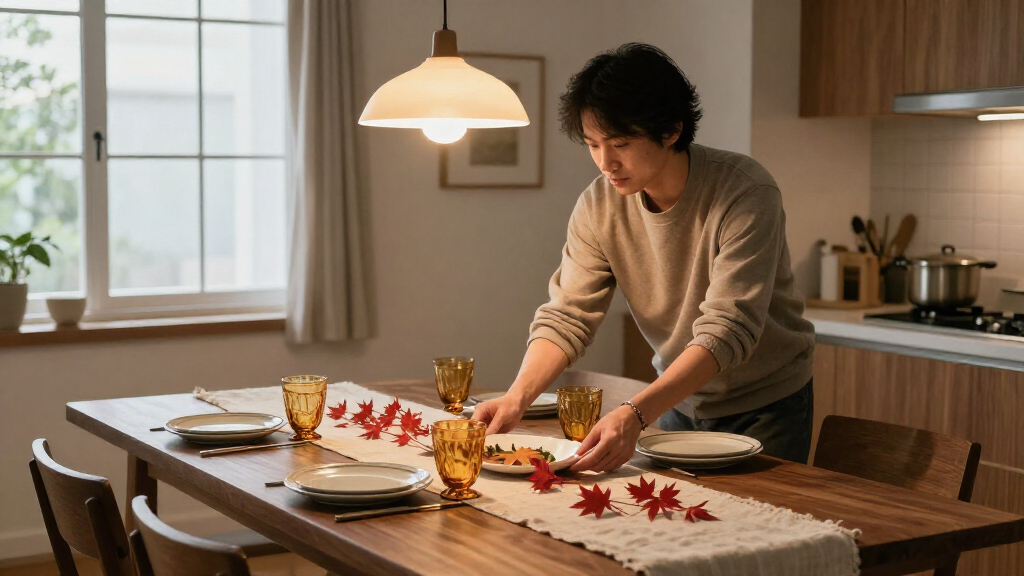
For the third and fourth lessons, Livingetc emphasizes how vessels relate to food and season. It describes the Japanese expression “the vessel is the kimono of the food” and recommends paying attention to a bowl’s weight, warmth and the open space around the food. For autumn, the report suggests replacing summer glass and white porcelain with warm clay and persimmon or rust glazes, then adding a small seasonal detail, such as a chrysanthemum-shaped chopstick rest. It advises making that change slightly ahead of the season.
A More Personal Autumn Table
The advice matters to hosts because it offers small, practical changes rather than requiring a new dining room or a complete matching set. A tray at each place can give guests a clear individual space, while shared platters keep food accessible. Personal bowls or a few carefully chosen small plates can also make a table feel considered without making every setting identical.
These are design suggestions, not evidence of a measured effect on guests or a claim that all Japanese households set tables in the same way. Their value for readers is the adaptable framework: consider how people eat together, what feels good to handle, and how a limited seasonal change can shape the meal.
Products Worth Considering

Sonos Era 100 SL Compact Microphone-Free Speaker, White

LG C2 Series 65-Inch OLED evo 4K Smart TV (OLED65C2PUA, 2022)

Shark Navigator Robot Vacuum with 30-Day Self-Emptying Base, White (AV2110S)
As an affiliate, we earn on qualifying purchases.
The Four Practices in Context
The source is a Livingetc advice report developed with Nakagawa, a craft maker and retailer founded in Nara in 1716, according to the article. It presents the recommendations as habits drawn from autumn tablescapes in Japanese homes and translates them for readers setting a Western table. The supplied material does not identify a survey, research study or formal review behind the advice.
The guide’s examples move from the arrangement of a meal to its materials: an oshiki creates a defined place for each diner; personal bowls and chopsticks make the setting less uniform; small plates, known as mame-zara, offer a way to collect different pottery styles; and seasonal colors or a single decorative object mark the shift toward autumn. The article also refers to shitsurai, a seasonal arrangement, as a small way to signal the time of year.
““The vessel is the kimono of the food.””
— Livingetc report
What the Guide Does Not Establish
The supplied report does not give a publication date, cite research measuring the effect of these practices, or establish how widely each approach is used across Japan. Its claims are presented as practical design guidance, and the suggested styles are not evidence of a single standard for Japanese homes.
It is also unclear from the source whether the recommendations were tested with hosts or guests. The article names Nakagawa as a craft partner and retailer, but the supplied text does not detail how its input shaped each recommendation. Readers should treat the ideas as editorial advice, not as a definitive account of Japanese dining customs.
Ways to Adapt the Ideas
For a reader planning an autumn meal, the next step is to try one or two of the practices with tableware already at home: set a small tray or defined place for each person, put shared dishes within reach, or mix a personal bowl with otherwise simple plates. A small dish can hold a condiment or snack, while a change in glaze or material can add a seasonal accent.
The report does not announce a follow-up study or other scheduled development. Its guidance is intended for readers to apply at their own tables, with the degree of change left to the host. A restrained approach—one seasonal detail rather than a full redesign—matches the article’s emphasis on changing the vessels while leaving the rest of the table alone.
Key Questions
What are the four Japanese tablescaping lessons?
Livingetc recommends combining individual place settings with shared dishes, choosing some tableware for the person using it, considering the vessel as part of the food’s presentation, and changing plates or bowls to reflect the season.
What does an oshiki hold?
The report describes an oshiki as a flat tray for an individual setting, holding items such as a rice bowl, soup bowl and small plate. Larger dishes are placed in the center for sharing.
Do the pieces need to match?
No. The guide suggests that personal bowls and chopsticks can be selected for individual preferences, while small plates and other tableware can be mixed. It does not require a fully matching set.
How does the guide suggest making a table feel seasonal?
It recommends changing the vessels—for example, bringing in warm clay or persimmon and rust tones for autumn—and adding one small seasonal detail, such as a chrysanthemum-shaped chopstick rest.
Source: livingetc.com