TL;DR

Get home appliances delivered free with Prime
- Fast, free delivery on millions of items
- Prime Video, Amazon Music and more included
- Member-only deals all year
A Livingetc report outlines five storage ideas drawn from Japanese kitchens: declutter before adding organizers, select containers for what they store, keep frequently used cooking items accessible, choose cookware that can also serve food, and limit counter displays. The advice is attributed mainly to designer Yoko Kloeden, with a comment from Nakagawa executive vice president Tasuku Ogino; it is design guidance, not a measured study of household outcomes.
Livingetc has published five kitchen-storage lessons drawn from Japanese design, including clearing out unused items before buying organizers and choosing cookware that can move from stove to table. The report, based on comments from London-based interior designer Yoko Kloeden and Nakagawa executive vice president Tasuku Ogino, offers practical advice for reducing clutter and making everyday cooking items easier to reach.
Kloeden’s first recommendation is to declutter before adding storage. Rather than immediately buying shelves, boxes or dividers, she suggests examining one shelf and asking what each item is for. The approach treats available space as limited and prioritizes keeping items that have a clear use. It may also help households avoid spending on organizers that simply make it easier to store things they do not need.
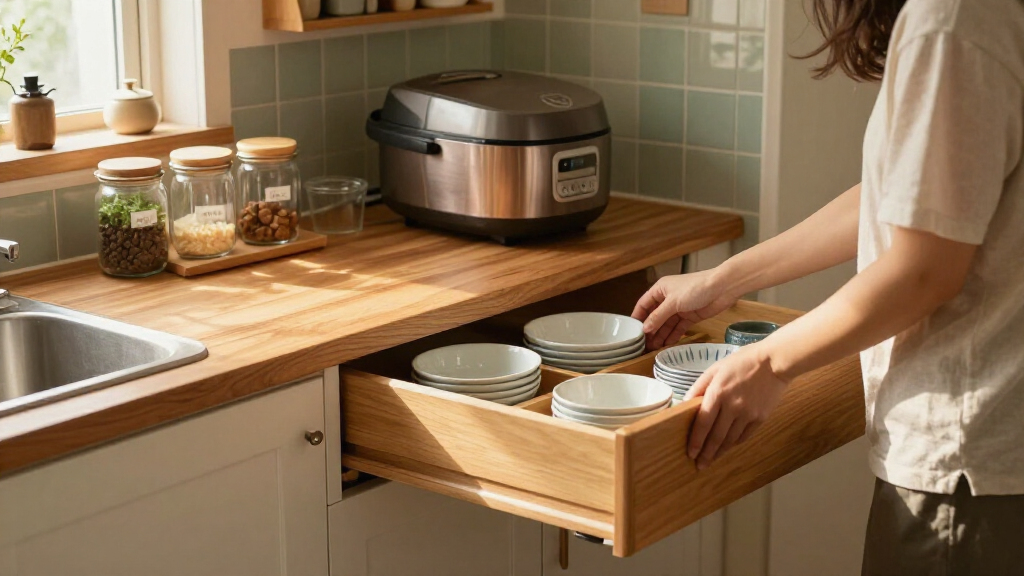
The report’s second lesson is to match a container to its contents and purpose. Kloeden points to paulownia, also called kiri, for dried goods and tea, and says its porous wood can buffer humidity. Clear plastic, by contrast, makes stored contents visible. Her broader advice is to choose a container for the function it performs, rather than selecting storage pieces solely because they match.
For items used repeatedly while cooking, Kloeden recommends easy-to-open vessels and convenient placement. She says salt and sugar can be kept in ceramic jars because they clump, and describes an ohitsu—a lidded vessel used for cooked rice—as a way to draw off steam. The point, she says, is practicality: a frequently used container should be manageable with one hand, not just attractive on a shelf.
Less Clutter, Smoother Cooking
The recommendations focus on daily kitchen use, not just appearance. Keeping common ingredients and utensils within reach can reduce interruptions during meal preparation, while limiting the number of stored items can free up cupboard and counter space. These are practical design principles rather than guarantees; the report does not provide research measuring how much time or space households save by following them.
Multipurpose cookware is another space-saving idea. Kloeden describes vessels that can store leftovers, reheat food and serve it, as well as flameproof clay cookware that can go from burner to table. Fewer transfers may mean fewer dishes to wash, and the food can remain in the vessel in which it was cooked. Whether a particular piece is suitable depends on its material, manufacturer instructions and cooking equipment.
The counter advice also balances utility with visual order. Kloeden says an item should be used daily and have visual presence to earn a place in view. That standard can help distinguish useful, deliberate displays from packaging and objects left out by default, while leaving the arrangement to individual needs and taste.
Japanese style kitchen storage containers
As an affiliate, we earn on qualifying purchases.
As an affiliate, we earn on qualifying purchases.
The Five Storage Principles
The report’s fifth lesson is to leave only selected items on the counter. Kloeden uses the Japanese phrase “dashite totonou,” which she explains as putting things out in an ordered way. In her account, items displayed should be both regularly used and visually suited to the space; branded packaging can instead be kept in a box.
Ogino describes the resulting visual contrast with the term merihari, which the report translates as deliberate contrast. The suggestion is not to make every kitchen look the same, but to create a considered balance between what is visible and what is stored away.
Taken together, the five lessons are: remove what is unnecessary, choose containers by function, make cooking essentials accessible, favor cookware with more than one role, and be selective about counter displays. Livingetc presents them as ideas to borrow from Japanese kitchens, not as rules followed uniformly in every Japanese home.
“Before you add storage, take one shelf and ask what each thing on it is for.”
— Yoko Kloeden, interior designer
As an affiliate, we earn on qualifying purchases.
Advice, Not Measured Results
The supplied report does not state a publication date, nor does it cite a study testing these ideas across households. The advice is attributed principally to Kloeden, with Ogino commenting on the visual principle of deliberate contrast. The article does not establish that the practices are universal across Japanese kitchens or that they produce the same results in every home.
Some material-specific claims, including the humidity and insect-related qualities attributed to paulownia, are presented in Kloeden’s comments rather than supported with independent testing in the supplied material. Readers should also check product guidance before using cookware for reheating, stovetop cooking or food storage; suitability depends on the item.
As an affiliate, we earn on qualifying purchases.
Start With One Shelf
For readers applying the advice, the report’s suggested first step is modest: review one shelf before buying anything. Identify what is used, remove items without a clear purpose, and then decide whether the remaining contents need different containers or a more accessible location.
From there, households can assess which ingredients and utensils are used during most cooking, whether any cookware can serve more than one role, and which counter items deserve to stay out. The supplied report does not announce a follow-up study or further development; it presents these ideas as practical design guidance.
As an affiliate, we earn on qualifying purchases.
Key Questions
What are the five Japanese kitchen-storage lessons?
Declutter before adding storage, choose containers for their function, keep regularly used cooking items accessible, select cookware that can also serve food, and display only a limited set of useful, visually suitable items.
Who is the advice attributed to?
The report quotes Yoko Kloeden, a London-based architecture and interior designer. It also cites Tasuku Ogino, Nakagawa’s executive vice president, on the idea of deliberate visual contrast.
Does the report show that these methods save a specific amount of space or time?
No. The supplied material offers design advice, not quantified results, and does not give measurements for space saved, time reduced or household outcomes.
What is a useful first step?
Review one shelf and ask what each item is for before buying organizers. Then choose storage based on how often an item is used and what its container needs to do.
Source: rss
Halloween Picks
halloween
As an affiliate, we earn on qualifying purchases.