TL;DR

Get home appliances delivered free with Prime
- Fast, free delivery on millions of items
- Prime Video, Amazon Music and more included
- Member-only deals all year
Task lighting is focused illumination designed to make a specific activity easier and more comfortable, rather than a particular fixture style. Lighting designers say it can be provided by many kinds of lights and should be planned around how people use each room.
Livingetc has published an explainer on task lighting, describing it as focused light for a specific activity, such as reading, cooking or working at a desk. The report draws on lighting designers’ advice that the term describes a function, not a fixture style—a distinction that can help homeowners plan rooms around daily routines rather than choosing lights for appearance alone.
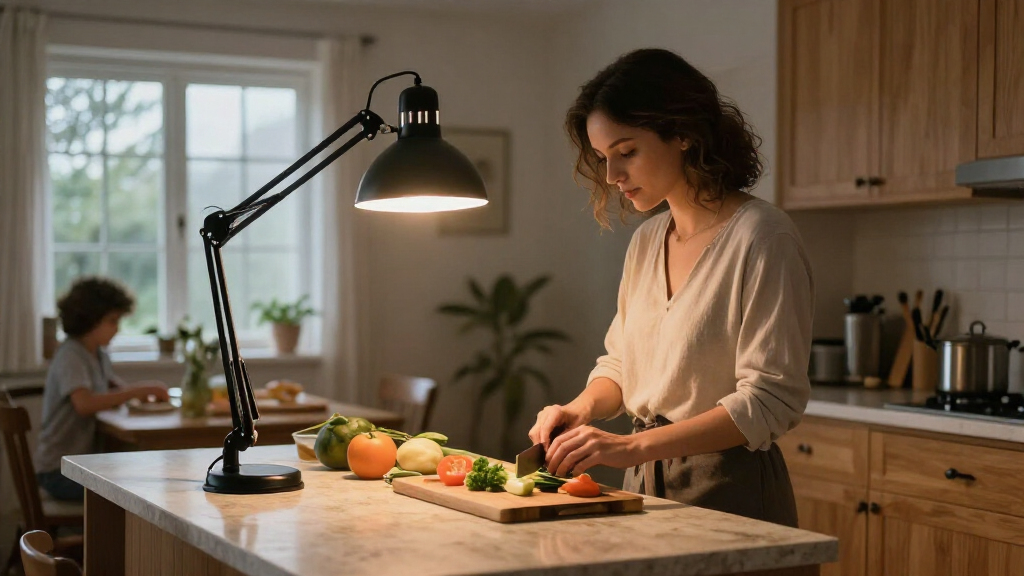
Vanessa Macedo, an associate lighting designer at John Cullen Lighting, defines task lighting as illumination directed where a particular activity takes place. Its purpose, she says, is to make that activity practical and comfortable without causing eye strain. Examples include light at a kitchen work surface, a desk lamp, a bedside reading light or illumination at a makeup area.
Kiersten Hoiland, founder of Hoiland Studios, also frames task lighting as a functional requirement rather than a specific look. A pendant can serve the purpose if it sends enough light onto a surface; a linear LED fixture can do the same. The relevant test is whether the light supports the task, not whether it belongs to a particular category of product.
The report says task lighting is useful beyond kitchens and bathrooms. A floor lamp beside an armchair may support reading, while a dining table used for work may need a fitting that illuminates its surface. Hallways call for comfortable light for movement, Macedo says, while kitchens require more deliberate illumination at work areas. These are design examples, not measurements or technical installation specifications.
Lighting That Supports Daily Routines
The distinction matters because a room can look finished yet still be difficult to use if its main activities are poorly lit. Focused illumination can make reading, food preparation or desk work easier, while relying only on decorative or general lighting may leave the relevant surface insufficiently lit. The designers’ advice is to identify what people actually do in a room before deciding where light is needed.
Task lighting also need not be treated as an unattractive utility. The source argues that a pendant, floor lamp or discreet linear fitting can meet a practical need while contributing to a room’s appearance. For homeowners, that means considering both where the light falls and how the fixture fits the overall design.
The article places task lighting within a layered scheme: task lighting supports activities, ambient lighting sets the general mood, and accent lighting draws attention to details such as artwork or materials. Those layers serve different purposes; the report does not claim that one replaces the others.
adjustable LED desk lamp with dimmer
As an affiliate, we earn on qualifying purchases.
As an affiliate, we earn on qualifying purchases.
From Fixture Choice to Light Function
The Livingetc report addresses a common point of confusion in home lighting: task lighting is often associated with bright overhead fittings or LED strips. Hoiland’s explanation broadens the definition, saying that different fixture types can qualify if they direct sufficient light to the place where an activity happens.
It also recommends tailoring a lighting plan to habits rather than treating every room as if it has identical needs. Questions such as whether someone reads in bed, works at the dining table or applies makeup at a sink can reveal requirements that a furniture layout alone may not show. The report presents this as design guidance from the named professionals, not as a formal lighting standard.
“Task lighting is lighting designed to support a specific activity, providing focused illumination exactly where it is needed.”
— Vanessa Macedo, associate lighting designer at John Cullen Lighting
swing arm wall mounted bedside reading light
As an affiliate, we earn on qualifying purchases.
As an affiliate, we earn on qualifying purchases.
No Technical Specifications Provided
The source offers design principles and examples, but does not specify target brightness, color temperature, fixture spacing or other technical criteria for particular rooms. It also does not provide product tests or evidence comparing different lighting setups. The advice should therefore be read as a general explanation of the term, not a measured standard or a guarantee that a particular fixture will suit every space.
The supplied material gives no publication date, and it does not identify a specific new product, regulation or industry change. The development is the publication of an explainer rather than a change in lighting requirements.
adjustable floor lamp for reading beside armchair
As an affiliate, we earn on qualifying purchases.
As an affiliate, we earn on qualifying purchases.
Plan Around Each Room’s Use
For homeowners applying the advice, the next step is to list the activities that happen in each room and identify the surfaces or areas where focused light would help. A reading chair, desk, kitchen counter or bedside table may each call for a different placement. Then consider how those focused sources work with ambient and accent lighting, rather than expecting one fixture to cover every need.
The report does not announce a follow-up study or a formal technical checklist. Any detailed selection or installation should be based on the room, the fixture’s specifications and the needs of its users; the source leaves those project-specific decisions open.
under cabinet LED task lighting for kitchen worktops
As an affiliate, we earn on qualifying purchases.
As an affiliate, we earn on qualifying purchases.
Key Questions
What is task lighting?
Task lighting is focused illumination intended to support a specific activity, such as reading, cooking, working or applying makeup.
Does task lighting have to come from a desk lamp?
No. The fixture’s style does not define its role. According to lighting designer Kiersten Hoiland, a pendant, floor lamp or linear LED fitting can provide task lighting if it directs enough light to the relevant area.
Where in a home can task lighting be useful?
It can be useful anywhere a person carries out an activity that benefits from focused light, including kitchens, bathrooms, bedrooms, living rooms and dining areas. The placement depends on how the room is used.
How does task lighting differ from ambient and accent lighting?
Task lighting supports an activity, ambient lighting provides general illumination and mood, and accent lighting highlights features such as artwork or architectural details, according to Macedo.
Source: rss
Fall yard work Picks
leaf blowers
As an affiliate, we earn on qualifying purchases.