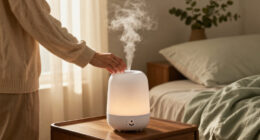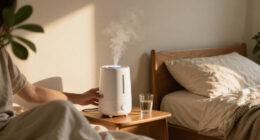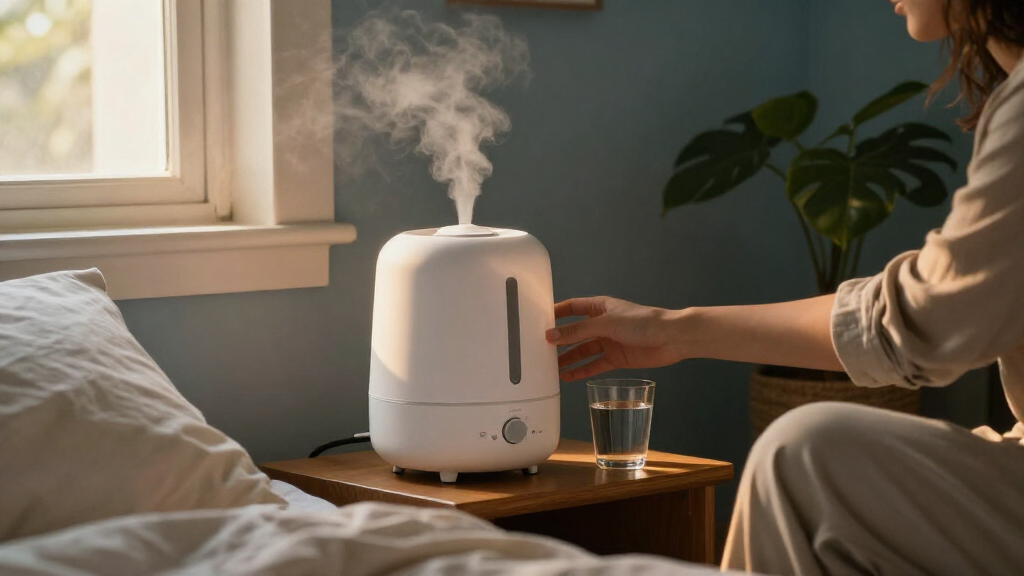

This guide helps you choose a suitable humidifier, place it safely in a bedroom, set a comfortable humidity level, and care for it between uses. It is for beginners who want to ease dry-air discomfort without making the room damp or encouraging mold. Initial setup takes about 20-30 minutes; routine care takes a few minutes each day.

Get home appliances delivered free with Prime
- Fast, free delivery on millions of items
- Prime Video, Amazon Music and more included
- Member-only deals all year

DREO 3L Humidifiers for Bedroom, 30H Runtime, 26 dB Quiet, New Edition
- ✔ Tank capacity: 3 liters
- ✔ Listed runtime: Up to 30 hours in sleep mode
- ✔ Noise: 26dB in sleep mode

Levoit Top Fill Humidifiers for Bedroom, 2.5L Tank for Large Room, 25dB
- ✔ Tank capacity: 2.5 liters
- ✔ Listed runtime: Up to 25 hours on low
- ✔ Noise: 25–28dB

Clarston Humidifiers for Bedroom, 2L Cool Mist Humidifier, 24dB Quiet Sleep
- ✔ Tank capacity: 2 liters
- ✔ Listed runtime: Up to 25 hours on low
- ✔ Noise: 24dB
Difficulty: Beginner | Time: 20-30 minutes to set up; a few minutes daily for care
What You’ll Need
Tools & Materials:
- Humidifier sized for the bedroom
- Clean water, following the device manual
- Hygrometer, unless the humidifier has a reliable built-in humidity display
- Stable, water-resistant surface near a power outlet
- Soft cloth and cleaning supplies specified by the manufacturer
Knowledge:
- Ability to follow the device manual
- Basic awareness of the bedroom’s size and available floor or table space
Read the humidifier manual before filling or cleaning it. Follow its water and cleaning instructions; some models call for distilled or demineralized water, while others permit tap water. If someone in the home has asthma, allergies, or another respiratory condition, ask a clinician whether a humidifier is appropriate and which type to use.
DREO 3L Humidifiers for Bedroom, 30H Runtime, 26 dB Quiet, New Edition
DREO takes the lead because it combines the largest tank in this lineup with the broadest stated coverage and the most involved controls. Its 3L capacity is paired with up to 30 hours in sleep mode, and the listing specifies a humidistat and adjustable humidity control. That gives us more room to tailor operation than the Levoit Classic 160’s single manual dial, particularly when bedroom conditions vary over the night.The 300-square-foot coverage claim also makes DREO the more plausible fit for a larger bedroom or an open sleeping area; Levoit lists 219 square feet and Clarston 260. It runs at a listed 26dB in sleep mode, close to Clarston’s 24dB and Levoit’s 25–28dB range. Its ambient lighting can be switched off, while an aroma tray adds an option the other two listings do not clearly provide in the same way. These extras broaden its use, but they also mean there are more settings and components to manage.We should keep expectations grounded: the 30-hour figure is for sleep mode, not necessarily higher output, and the supplied details do not describe the tank opening or cleaning access as fully as Levoit’s. DREO is also the heaviest here at 2.6 pounds and lists 29 watts. Choose it when room coverage and humidity adjustment matter; skip it if we want the simplest possible unit or do not need its additional controls.
Pros:
- 3L tank with up to 30 hours of runtime in sleep mode
- Humidistat and adjustable humidity control are listed
- Broadest stated coverage in this group at up to 300 square feet
- Sleep mode is listed at 26dB, and ambient lighting can be switched off
Cons:
- Runtime claim applies to sleep mode; higher output can require more frequent refills
- At 2.6 pounds, it is heavier than Levoit and Clarston
- The supplied product details give less specific cleaning-access information than Levoit’s
Best for: Bedroom owners who want a larger stated coverage area, longer low-output runtime, and humidity control beyond a basic mist dial.
Not ideal for: Buyers who prefer a minimal control setup, want the lightest model, or need a clearly documented wide-mouth cleaning design.
Bottom line: DREO is our strongest all-around bedroom choice when we want wider stated coverage and humidity controls in one unit.
“DREO is our strongest all-around bedroom choice when we want wider stated coverage and humidity controls in one unit.”
Levoit Top Fill Humidifiers for Bedroom, 2.5L Tank for Large Room, 25dB
Levoit’s strongest bedroom argument is how little its routine asks of us. The top-fill tank and wide opening make refilling and reaching inside for cleaning more straightforward than a design that requires flipping a tank. Its 2.5L capacity is between DREO’s 3L and Clarston’s 2L, and the listing gives a clear up-to-25-hour runtime on low. For a small or medium bedroom, that combination supports a simple overnight setup without adding a humidistat or digital controls.Its sleep-focused details are unusually clear: the listing specifies 25–28dB operation and says the lights turn off. That is a useful distinction from Clarston, whose listed 24dB is lower but whose product information also mentions a night light. The Levoit uses a one-knob manual mist adjustment and a 360-degree nozzle, which keep operation uncomplicated, though we have to set output ourselves. DREO is the better fit if we want humidity control or more stated coverage; Levoit makes more sense when we value a plain dial and accessible cleaning.There are limits. Levoit lists coverage up to 219 square feet, the smallest stated area here, so we should look elsewhere for a larger room. The 25-hour runtime applies at the lowest setting, and its filter cotton may need replacement about monthly depending on water hardness. The listing recommends purified or distilled water to reduce white dust. This is a practical, easy-to-understand choice, but it asks us to handle humidity and maintenance manually.
Pros:
- Top-fill design and wide opening make tank access and cleaning easier
- Up to 25 hours on low from a 2.5L tank
- Lights-off sleep setup and listed noise range of 25–28dB
- Simple dial and 360-degree nozzle offer direct mist adjustment
Cons:
- Coverage is listed at 219 square feet, below DREO and Clarston
- No built-in humidistat or automatic humidity mode is specified
- Filter cotton may need replacement, and hard water can contribute to white dust
Best for: Light sleepers and bedroom users who want a quiet, light-free unit with accessible cleaning and uncomplicated manual controls.
Not ideal for: Owners of larger bedrooms who want a humidistat, automatic humidity adjustment, or the longest listed low-setting runtime.
Bottom line: Levoit is the simplest pick for a small or medium bedroom where easy cleaning and a dark sleep environment matter most.
“Levoit is the simplest pick for a small or medium bedroom where easy cleaning and a dark sleep environment matter most.”
Clarston Humidifiers for Bedroom, 2L Cool Mist Humidifier, 24dB Quiet Sleep
Clarston is the lightest option here, at 1.7 pounds, and lists the lowest noise level at 24dB. Those details make it appealing when a humidifier needs to fit on a crowded bedside surface or move between rooms. Its 2L tank is the smallest in this comparison, yet the listing still claims up to 25 hours on low. Compared with Levoit’s 2.5L tank, Clarston trades some water capacity for a shorter, lighter body; DREO remains the better choice if we need more capacity and automated humidity controls.The bedside details are well targeted: a light-off feature supports a dark room, automatic shutoff is listed, and the 360-degree nozzle lets us direct mist. Clarston also claims up to 260 square feet of coverage, placing it between Levoit and DREO on paper. Its 200ml-per-hour high-output mode is specified for faster moisture delivery, but the supplied information does not say how long the tank lasts at that setting. As with the other ultrasonic models, we should use an appropriate hard surface and avoid placing it where mist can dampen nearby belongings.Clarston’s wide six-inch opening and top-fill lid make cleaning and refilling more accessible, and an aroma feature may appeal to buyers who want fragrance alongside moisture. However, the supplied specs list 25 watts, more than Levoit’s 17 watts, and the product information is less detailed about humidity controls and filtration than DREO’s. The night-light description also sits alongside a total light-off feature, so we should check the available setting behavior if bedside darkness is essential. It suits a compact setup, but the smaller tank and less complete control details keep it third overall.
Pros:
- Lightest model in this comparison at 1.7 pounds
- Listed 24dB operation and a light-off feature
- Top-fill design with a six-inch opening for easier access
- Claims coverage up to 260 square feet and includes a 360-degree nozzle
Cons:
- Smallest tank here at 2L
- Humidity automation and filtration details are not clearly specified
- Listed power draw of 25 watts is higher than Levoit’s 17 watts
Best for: People seeking a lightweight humidifier for a compact bedroom or nursery who value quiet operation, top filling, and easy access for cleaning.
Not ideal for: Buyers who want the largest tank, specified humidity automation, or the clearest information about filtration and control options.
Bottom line: Clarston is a compact, quiet option when portability and bedside fit outweigh the benefits of a larger tank or more detailed controls.
“Clarston is a compact, quiet option when portability and bedside fit outweigh the benefits of a larger tank or more detailed controls.”
As an Amazon Associate we earn from qualifying purchases.
Before You Start
Check the room for existing dampness, condensation, or mold. A humidifier adds moisture and can worsen these problems. Aim for indoor relative humidity around 30-50%, and keep it below 60%; use a separate hygrometer to check the room if the device does not show humidity. Do not place the unit where mist can wet bedding, curtains, walls, electronics, or flooring. Keep it out of a child’s reach, and follow the manual’s electrical and burn-safety instructions.
Step-by-Step Instructions
Step 1: Choose a suitable humidifier
Measure or estimate the bedroom’s floor area and compare it with the coverage listed on the humidifier. Choose a unit rated for that room size, with a tank that suits how often you can refill it. Review the manufacturer’s cleaning instructions and replacement-filter schedule before buying or using the device. If mineral dust is a concern, check whether the model supports distilled or demineralized water.
Tip:Warm-mist models heat water and can cause burns if tipped or touched. In rooms used by children, consider a cool-mist model and follow all child-safety instructions.
Check: The unit’s stated coverage includes the bedroom, and you know what water and cleaning routine its manual requires.
Step 2: Select a safe location
Place the humidifier on a stable, level, water-resistant surface where it cannot be knocked over. Keep it several feet from the bed and away from walls, curtains, books, electronics, and the room’s heater or vent. Direct the mist into open space rather than toward a person or surface. Position the cord so no one can trip over it, and plug the unit into an outlet according to the manual.
Tip:Do not set a humidifier directly on wood or other surfaces that can be damaged by moisture unless the manufacturer permits it and the surface is protected.
Check: The unit is stable, its mist has a clear path, nearby objects stay dry, and the cord does not cross a walkway.
Step 3: Clean and fill the tank
Unplug the unit before handling it. Wash your hands, remove the tank, and clean or rinse it as the manual directs. Fill it with the specified water without exceeding the marked maximum line. Wipe up spills, refit the tank securely, and dry the outside before returning the unit to its base.
Tip:Do not add essential oils, medication, or fragrances to the tank unless the manual specifically says the model is designed for them. Additives can damage some humidifiers or release substances into the air.
Check: The tank is correctly seated, the outside is dry, and there is no water around the base or outlet.
Step 4: Set humidity and run the unit
Turn on the humidifier at a low setting or set its humidistat to target roughly 30-50% relative humidity. Check the room reading with a hygrometer after the unit has run for a while, and adjust the output to keep humidity below 60%. Use the timer or auto shutoff if available. Turn the unit down or off if you see condensation on windows or dampness on nearby surfaces.
Tip:Do not assume that a built-in reading reflects every part of the room. A hygrometer placed away from the mist can give a more representative reading.
Check: The room feels comfortable, the hygrometer stays in the target range, and bedding, windows, and nearby surfaces remain dry.
Step 5: Empty and dry it regularly
At least once a day, switch off and unplug the humidifier. Empty any remaining water, rinse the tank as directed, and let the parts air-dry before refilling. Do not leave old standing water in the unit between uses. Follow the manual’s schedule for a more thorough cleaning, and replace filters or other parts at the stated intervals.
Tip:Never mix cleaning products. Use only the method and products specified in the manual, rinse as directed, and keep cleaning agents away from children and pets.
Check: The unit has fresh water, no visible film or residue, and no stale or musty odor.
Common Mistakes to Avoid
- Topping up old water without emptying and cleaning the tank. — Empty and rinse the tank daily, then follow the manual’s full cleaning and filter schedule.
Troubleshooting
Problem: Windows or nearby surfaces become damp.
Solution: Turn the output down or switch the unit off. Move it farther from windows and walls, ventilate the room if appropriate, and check humidity with a hygrometer. Do not resume normal use until the room is dry and humidity is below 60%.
Problem: White dust appears on furniture.
Solution: Check the manual’s water recommendations. If the model permits it, use distilled or demineralized water, then wipe away the residue with a damp cloth. Clean the unit as directed.
Problem: The humidifier smells musty or looks slimy.
Solution: Unplug it and stop using it. Empty and clean the tank and other parts according to the manual, rinse as specified, and let everything dry. Replace filters if required. If the odor or film remains, contact the manufacturer before using it again.
Problem: The room still feels dry even when the humidifier runs.
Solution: Check that the tank has water, the unit is assembled correctly, and the filter is clean or due for replacement. Confirm room humidity with a hygrometer and verify that the device is rated for the bedroom size. Do not raise output above the safe humidity range.
What Success Looks Like
The humidifier sits securely in a suitable location, operates according to its manual, and raises bedroom humidity to a comfortable level around 30-50% without exceeding 60%. No condensation, wet fabrics, water damage, white residue, or musty odor should appear. The tank is emptied and cared for on schedule.
Next Steps
Check the hygrometer and nearby surfaces each day you use the unit. Empty and dry the tank daily, and clean the device and replace filters on the schedule in its manual. Stop using it if dampness, mold, or persistent odor develops; correct the moisture problem before restarting. If symptoms persist or worsen despite comfortable humidity, seek medical advice rather than increasing the humidity further.
Frequently Asked Questions
What humidity level should I aim for in a bedroom?
Aim for about 30-50% relative humidity and keep it below 60%. If condensation or dampness appears, reduce the output or turn the unit off, even if the displayed reading seems acceptable.
Can I leave a bedroom humidifier on all night?
You can if the manual permits it, the unit is in a safe location, and humidity stays within range. Use a humidistat or timer when available, and turn the unit off if the room becomes damp.
Should I use tap or distilled water?
Use the kind of water specified by the manufacturer. Distilled or demineralized water can reduce mineral dust in some models, but not every device requires it.
How often should I clean the humidifier?
Empty and rinse the tank daily, then clean the unit at the intervals and by the method in its manual. The exact schedule depends on the model, water, and how often it runs.
Can I put essential oils in the tank?
Only if the manual says the humidifier is designed for essential oils. Otherwise, oils may damage the unit or affect the air; use a separate diffuser if appropriate and follow its instructions.