TL;DR

Get home appliances delivered free with Prime
- Fast, free delivery on millions of items
- Prime Video, Amazon Music and more included
- Member-only deals all year
Ideal Home has published six practical suggestions for drying laundry indoors while limiting moisture buildup: remove more water in the washer, space garments out, use suitable drying equipment, and ventilate the room. The advice is not a guarantee against damp or mould; results depend on the room, load and conditions.
Ideal Home has published six recommendations for drying laundry indoors in cold or wet weather, when outdoor drying may not be practical. The advice focuses on removing more water before hanging clothes, allowing airflow around garments and managing moisture in the room—steps intended to limit condensation that can contribute to damp and mould.
The guide advises running an extra spin cycle before taking clothes out of the washing machine, provided the selected spin speed is suitable for the fabrics. It says this can be especially useful for heavier items such as towels, jeans and bedding, which retain more water and can take longer to dry. Less water left in the laundry means less moisture released as it dries indoors.
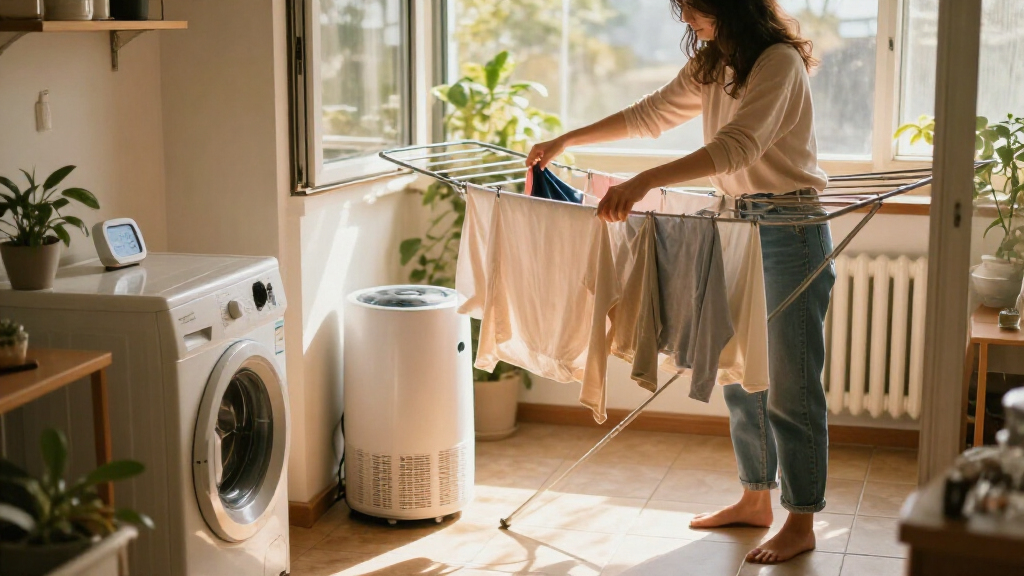
On the airer, the recommendation is to leave space between garments rather than crowding the rack. Spread out sleeves, open shirts and avoid folding trouser legs over one another so air can circulate. Lauren Roelofs, identified in the article as a laundry expert at Brabantia, says leaving room between clothes helps them dry more evenly. The guide also suggests turning heavier pieces partway through drying to reduce damp patches.
The remaining suggestions are to use a heated clothes airer if appropriate, pair the drying setup with a dehumidifier, position the airer where air can circulate and ventilate the room. Ideal Home notes that a cover for a heated airer may trap warmth around clothes and that drying times vary with the load and conditions. A dehumidifier can remove moisture from room air, while ventilation can help disperse humid air; neither measure makes outcomes identical in every home.
How Indoor Drying Adds Moisture
Wet laundry releases water into the air as it dries. In a room with limited ventilation or moisture removal, that humidity can contribute to condensation on cooler surfaces. Repeated moisture buildup may be a concern for households already dealing with poor airflow or damp, although the article does not claim that indoor laundry alone causes mould.
The practical value of the advice is that it addresses both sides of the problem: getting clothes dry and dealing with the moisture they release. Spacing clothes and using an extra spin cycle may help reduce drying time, while a dehumidifier or ventilation addresses humidity in the room. These options vary in cost and suitability, so the guide does not present a single product as necessary for everyone.
Products Worth Considering

eufy Security E30 4K Indoor Camera, 2-Pack

Sonos Era 100 SL Compact Microphone-Free Speaker – Black

Samsung 85-Inch QN70H Neo QLED 4K Smart TV (2026)
As an affiliate, we earn on qualifying purchases.
Six Habits in the Guide
The article is framed around colder, wetter weather, when outdoor lines may be less useful and households may rely more on indoor airers. Its six recommendations are: run an extra spin; leave gaps between clothes; consider a heated airer; use a dehumidifier alongside the airer; choose a position with airflow and some distance from walls; and ventilate the room.
It names Lauren Roelofs of Brabantia and Catrin Parry, described as a buying lead at Lakeland, as sources for advice on spacing garments and using drying equipment. The article also includes product examples, but those are recommendations in a home-and-shopping feature, not independent evidence that a particular model is required or will prevent damp.
“One of the simplest ways to speed things up is to avoid overcrowding your drying rack. Leaving space between garments allows air to circulate, helping clothes dry more evenly.”
— Lauren Roelofs, laundry expert at Brabantia, as quoted by Ideal Home
Results Depend on Room Conditions
The supplied article does not give a publication date, independent testing data for the six habits or measurements of how much they reduce indoor humidity. It also does not establish a universal drying-time improvement: the article says times vary with the laundry load and conditions.
Whether these steps are enough to address condensation will depend on factors such as room ventilation, the amount of laundry, the building and the weather. The guidance does not promise that following it will prevent damp or mould, and it does not replace addressing an existing moisture problem.
Applying the Advice at Home
The immediate next step for readers is to adapt the suggestions to their laundry and space: check fabric care instructions before selecting a spin speed, avoid overcrowding the airer and place it where air can move around it. Where indoor drying is frequent, readers can consider whether ventilation or a dehumidifier is suitable for the room and household.
The source provides no announced follow-up study, policy change or scheduled next development. Its guidance remains practical advice rather than a formal standard; the relevant next measure is whether the drying setup reduces lingering humidity and condensation in a particular home.
Key Questions
What are the six recommendations for drying laundry indoors?
Ideal Home suggests an extra spin cycle, space between garments, a heated airer where useful, a dehumidifier, careful airer placement and room ventilation.
Why leave space between clothes on an airer?
Spacing allows air to circulate around garments and can help them dry more evenly, according to Brabantia laundry expert Lauren Roelofs, quoted by Ideal Home.
Does a heated clothes airer remove moisture from the room?
The guide distinguishes the two functions: a heated airer warms laundry to help it dry, while a dehumidifier removes excess moisture from the air. A heated airer by itself is not described as removing that moisture.
Should I open a window while drying clothes indoors?
The guide recommends ventilating the room to help manage humid air. The suitable approach will depend on conditions in the home; the supplied material gives no specific ventilation duration or temperature advice.
Will these steps guarantee that mould does not develop?
No guarantee is given. The article presents the habits as ways to manage drying and moisture, but outcomes depend on the room, ventilation, laundry load and other conditions.
Source: idealhome.co.uk